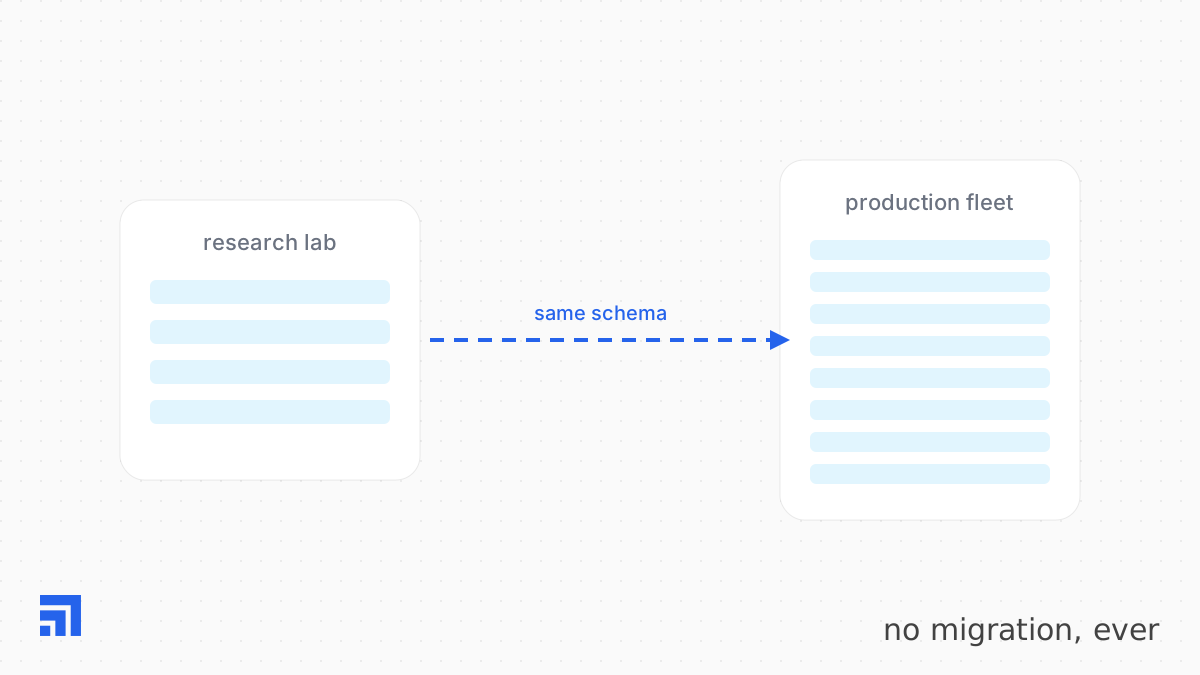
A research team records fifty episodes with a handheld rig, labels them in a weekend, and trains a policy that works in the lab. Eighteen months later the same task runs on forty robots across three facilities. Between those two moments, most programs rebuild their data pipeline at least twice — new schema, new tools, new conventions — and lose history each time.
What breaks at each step
The lab's ontology has a dozen classes; production needs two hundred. The lab labeled outcomes as free text; production needs an enumeration. The lab's episodes were one task; production episodes chain several. The lab evaluated by watching; production needs frozen suites per facility. Each mismatch triggers a migration, and each migration loses the provenance that made the earlier decisions defensible.
Designing for the fleet on day one
The alternative is a schema that scales without changing shape. Ours has four properties that make that possible.
Versioned ontologies. Classes, sub-tasks, and outcomes are versioned objects, not strings. Adding two hundred classes is an ontology version, not a schema change. Labels record which version applied, so old and new coexist.
Hierarchical episodes. The episode–attempt–sub-task structure is recursive. A production episode that chains three lab tasks is an episode whose sub-tasks are themselves structured. Nothing about the lab data needs to change.
Metadata as first-class fields. Facility, embodiment, operator, and conditions are typed fields from the start. The lab fills in one facility; the fleet fills in three. Evaluation slices by them in both cases.
Provenance on everything. Because every label already carries its decision history, there is nothing to reconstruct when the program grows. The fifty lab episodes are still in the fleet dataset, still auditable, still slicing correctly.
Growth should add rows, not rebuild tables.
Delivery grows the same way
The same principle applies to how the work is done. A lab runs self-serve. A product team adds managed capacity before a release. An enterprise program goes hybrid with sensitive tasks in-house. In Agentuor these are routing rules on one workspace, not separate systems. The guidelines, gold sets, and quality thresholds carry across all three.
Research to production is a journey most robotics programs make exactly once. The data infrastructure should not make them do it three times.